


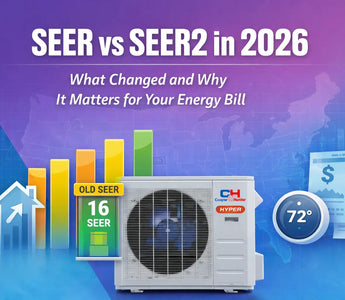
SEER vs SEER2 in 2026: A Clear Guide for U.S. Homeowners
Learn what changed, how to convert old ratings, and which mini split can save you thousands.
Key Takeaways
- The New Standard: SEER2 uses tougher, more realistic DOE lab tests than the old SEER rating.
- The Conversion: Old SEER ratings map roughly to SEER2 × 0.95. A legacy 14 SEER unit ≈ 13.4 SEER2.
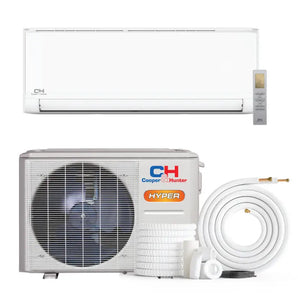
- The Efficiency Gap: Code-minimum ACs are ~13.4 SEER2. Cooper & Hunter mini splits reach 22+ SEER2.
- Bill Impact: Upgrading to 18–22 SEER2 can cut cooling energy use by 20–40%.
Introduction

At MiniSplitsForLess.com, we break down the U.S. Department of Energy’s new SEER2 rules so your 2026 energy bill isn’t a surprise.
If you have been shopping for a new air conditioning system recently, you have likely encountered a confusing alphabet soup of acronyms. For decades, homeowners were told to look for "SEER." It was the gold standard.
But in 2026, the landscape has shifted permanently. The DOE fundamentally changed how air conditioners are tested to better reflect reality. The result is SEER2—a rating system that looks lower on paper but delivers a more accurate prediction of what you will actually pay the utility company.
SEER vs SEER2: The Quick Snapshot
The Golden Rule of 2026
SEER2 uses tougher tests. A quick rule for comparing equipment:
SEER2 ≈ SEER × 0.95The "Milkshake" Analogy
Why are the numbers different? Think of your air conditioner's blower fan like a person drinking a milkshake.
The Old SEER Test
Tested against very low "static pressure" (0.1 in. w.c.). Like drinking a melted milkshake through a wide straw. The fan works easily, so efficiency looks artificially high.
The New SEER2 Test
Tested against 5x higher pressure (0.5 in. w.c.). Like drinking a thick milkshake through a coffee stirrer. The fan works harder, so the rating number drops.
How Old SEER Numbers Translate in 2026
Since the physics of the equipment didn't change—only the ruler we measure it with—use this map when shopping:
| Old Rating (SEER) | New Rating (SEER2) | Context |
|---|---|---|
| 14 SEER | ~13.4 SEER2 | National Minimum (North) |
| 15 SEER | ~14.3 SEER2 | National Minimum (South/Southwest) |
| 16 SEER | ~15.2 SEER2 | "Sweet Spot" for basic tax credits |
| 18 SEER | ~17.1 SEER2 | High Efficiency (Entry Inverter) |
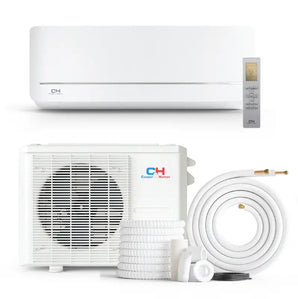
| 22 SEER | ~20.9 SEER2 | Premium (Cooper & Hunter Mia/Sophia) |
How SEER2 Affects Your Energy Bill
Moving from code-minimums (13.4 SEER2) to high-efficiency mini splits (21 SEER2) can save significant money.
The Math of Savings (Hot Climate Scenario)
Option A: Legal Minimum (14.3 SEER2)
Estimated Annual Cost: ~$1,300
Option B: High-Efficiency Mini Split (21 SEER2)
Estimated Annual Cost: ~$800
Result: You save ~$500/year. Over 15 years, that is $7,500 in savings.
Choosing SEER2 Levels: Brand Guide
Best For: Maximum long-term savings and premium comfort.
Ideal for regions with high electricity rates. Models like the Sophia or Mia offer the highest ROI over time.
Best For: Value efficiency.
The "Toyota Camry" of mini splits. Smart shoppers get high efficiency without the premium price tag. Great for rentals.
Best For: Cost-effective solutions.
Perfect for garages, workshops, or guest rooms. Exceeds DOE mandates at a budget-friendly entry price.
Technical Deep Dive: The Science of SEER2
For those who want to understand the engineering behind the purchase.
Why Mini Splits Win the "M1" Test
The new M1 test procedure penalizes systems that have to push air through restrictive ductwork (static pressure). Ductless mini splits bypass this penalty entirely.
Because they have no ducts, they don't suffer from static pressure losses or thermal loss in attics. This is why a standard central AC struggles to hit 16 SEER2, while a mid-range mini split easily cruises past 19 or 20 SEER2.
ROI Calculation: 4-Zone Home
Bravo (17 SEER2): Saves ~$2,880 over 10 years vs old system.
Cooper & Hunter (21.5 SEER2): Saves ~$3,960 over 10 years.
Note: If the high-efficiency unit qualifies for IRA tax credits, it may end up cheaper to buy than the standard unit.
Frequently Asked Questions
SEER is the older efficiency rating. SEER2 uses a new DOE test with higher ductwork static pressure (0.5 in. w.c. vs 0.1), so numbers look about 4–7% lower for the same system but better match real-world energy use.
A quick rule is SEER2 ≈ SEER × 0.95. For example, a 16 SEER system will test around 15.2 SEER2.
No, SEER2 specifically measures cooling efficiency. For heating efficiency in heat pumps, you should look at the HSPF2 rating.
14.3 SEER2 meets the legal minimum for the South and Southwest. It is code-legal but basic. Stepping up to 18–22 SEER2 offers better humidity control, comfort, and 20-40% energy savings.
Ready to lower your energy bill?
Don't just guess. Compare SEER2 ratings and find the perfect inverter system for your home.
Shop SEER2 CollectionsDisclaimer: SEER2 ratings describe equipment efficiency under standardized lab tests. Actual savings depend on installation quality, climate, and usage. Consult a licensed professional.