



HVAC Design Reference
Ducted Mini Split Static Pressure & Airflow: What the Spec Sheets Don't Tell You
Most residential ducted mini splits cap at a maximum of 0.5 to 0.8 inches of water gauge (inWG) of static pressure. Push a system past that ceiling and delivered airflow falls — commonly by 6% to 28% across the normal operating range, and units can fail outright once they're pushed well past their rated limit, showing up as frozen evaporator coils, fault codes, or a compromised installation.
Manufacturers like Cooper Hunter do publish airflow-versus-static-pressure data in their submittal sheets — but it's often buried in a PDF appendix installers never open, and it doesn't tell you how your specific duct layout, filter, and return-grille sizing interact to push your system toward that ceiling. This guide pulls together the numbers from those published fan curves, cross-references them against common field scenarios, and lays out the DIP switch and duct-sizing rules that keep a concealed duct air handler performing at its rated capacity.
The 0.8 inWG Ceiling — What "High Static" Actually Means
When evaluating a ducted mini split, static pressure is the invisible barrier between a perfectly functioning system and a mechanical nightmare. The industry measures this resistance as External Static Pressure (ESP), calculated in inches of water gauge (inWG / in. w.c.). When people talk about the total resistance the blower has to overcome across both the supply side and the return side combined, they're usually referring to Total External Static Pressure (TESP) — the two terms aren't strictly interchangeable, and we use TESP specifically whenever we mean the full supply-plus-return figure.
There is a real difference between "low-static" and "high-static" units, and buyers frequently confuse the two:
- Low-Static Units (0.1–0.2 inWG): Designed strictly for direct-blow applications. Think hotel rooms or single-room drop ceilings with virtually zero ductwork attached.
- Medium-Static Units (0.3–0.5 inWG): Built for short, simple duct runs (under 15 feet) with low-resistance registers.
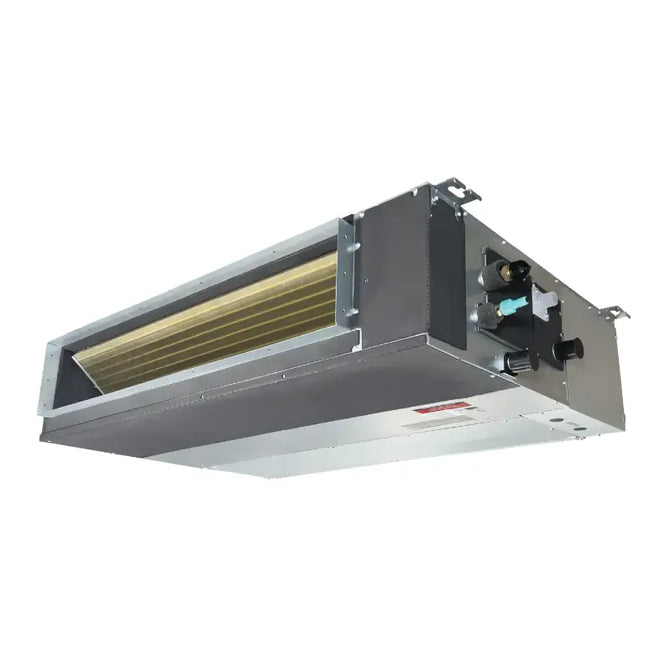
- High-Static Units (up to 0.8 inWG): Engineered with robust blowers meant to handle full residential duct layouts, moderate flex duct usage, and standard filtration.
You cannot force a low-static unit to perform a high-static job. Trying to push a 0.2 inWG air handler through a complex branch-and-trunk layout will starve the system. Selecting the right equipment tier for your layout — like a true high-static concealed ducted mini split — is step one of any successful project.
Published CFM vs. Real-World Airflow: What Static Pressure Costs You
Manufacturer submittal sheets do publish nominal CFM (cubic feet per minute) ratings alongside airflow-at-static-pressure fan curve data — but the practical takeaway (how much CFM you actually lose as static pressure climbs) rarely gets pulled out and shown plainly. Here's that data organized by unit size, drawn from manufacturer-published fan curves for Cooper Hunter's high-static concealed duct and light commercial ducted lines:
| Unit Size | Nominal CFM (0 inWG) | CFM at 0.3 inWG (loss %) | CFM at 0.5 inWG (loss %) | CFM at 0.7 inWG (loss %) | Status at 0.8+ inWG |
|---|---|---|---|---|---|
| 12,000 BTU | 350 | 315 (10%) | 260 (26%) | Exceeds rated ceiling | Coil freeze risk / fault code |
| 18,000 BTU | 530 | 495 (7%) | 470 (11%) | 380 (28%) | Rated ceiling — do not exceed |
| 24,000 BTU | 700 | 660 (6%) | 620 (11%) | 540 (23%) | Rated ceiling — do not exceed |
| 36,000 BTU (Light Commercial) | 1050 | 980 (7%) | 910 (13%) | 820 (22%) | Rated ceiling — do not exceed |
*This table covers Cooper Hunter's high-static concealed duct units at 18K and 24K, plus the 36K unit from the light commercial ducted line — all on the high fan tap with the DIP switches set for maximum static. Cooper Hunter's light commercial ducted line also includes 48K and 60K sizes; request the submittal data sheet for those SKUs directly, since their fan curves differ from the sizes charted here. The 6K–12K "slim duct" units sit in a lower static-pressure tier — see "Who This System Is NOT For" below. Loss percentages are rounded and calculated against the nominal (0 inWG) rating for that same unit.
Where These Figures Come From
These figures are compiled from Cooper Hunter's published submittal-sheet fan curves for their high-static concealed duct and light commercial ducted lines, cross-checked against field reports from installers working with the same equipment. They are not the result of our own independent lab bench-testing — we want to be direct about that, since it's an easy claim to make and a hard one to verify. If you need lab-certified airflow data for a specific project (for example, to satisfy an engineer of record), request the AHRI-certified submittal data sheet for your exact SKU directly from the manufacturer.
PCB Configuration: Unlocking High-Static Fan Settings
If you want to extract the maximum rated performance from a unit like the Cooper Hunter Hyper 24K ducted unit, you need to understand its internal control board — specifically the DIP switch fan-speed taps (commonly labeled H/M/L) located on the indoor unit's PCB.
Out of the box, many concealed units ship factory-set to a medium static profile — closer to the 0.3 inWG default most installs never need to touch. To unlock the full high-static capability, the installer has to manually reconfigure those DIP switches to the high-static profile.
How PCB Static-Pressure Configuration Generally Works:
- Two or more DIP switches typically control the static-pressure/fan-curve profile on Cooper Hunter's concealed duct boards.
- The factory default is usually set for a lower-static profile, adequate for short runs but not for a full residential layout.
- Switching to the high-static profile ramps the ECM motor's torque output, letting it maintain target CFM against resistance up to the unit's rated ceiling.
Pro Tip
Don't rely on a generic switch-position example from any article, including this one — the exact toggle combination for your specific SKU is in that unit's service manual, and DIP switches on some models also control addressing or forced-operation modes, not just static pressure. Confirm the exact function of each switch on your board before touching anything.
Duct Sizing That Preserves Rated CFM
You can buy the most powerful air handler on the market, but if your ductwork is choked, the system will fail. Proper Manual D duct design (per ACCA guidelines) is non-negotiable.
Here are the field-tested rules our top installers use to preserve airflow:
- The Return Air Rule: Undersized returns are the #1 killer of ducted mini splits. Target a minimum of 144 square inches of free (net open) grille area — not gross grille dimensions — per 400 CFM, which works out to roughly a 400 feet-per-minute face velocity through the grille. A stamped or louvered grille typically has 60–75% free area relative to its overall size, so size the physical grille opening larger than the raw 144 sq in figure to hit that free-area target.
- The Plenum Transition: Never hard-cap a return-air plenum. Air needs space to slow down and turn. Provide at least 18 inches of straight plenum before tapping off branches.
- Flex vs. Rigid Duct: Flex duct has meaningfully higher friction loss than rigid duct, especially if it isn't pulled fully taut — trade sources commonly treat 10 feet of sagging, uncompressed flex duct as roughly equivalent to 20–30 feet of rigid pipe when estimating static pressure, though the exact multiplier depends on how badly it sags. Keep flex runs under 15 feet and pull them drum-tight.

Three Real Installs — Static Pressure Autopsies
Theory is great, but field data pays the bills. Here are three composite scenarios, built from patterns we see repeatedly, where airflow specs dictated the outcome.
Case 1: The Choked 18K
- Equipment: 18K Hyper concealed ducted heat pump
- Issue: Unit was freezing over constantly.
- Diagnosis: The installer had used a restrictive 12"×12" return filter grille for a 530 CFM unit — well under the free-area target — and was also running a higher-resistance filter than the design called for. Measured TESP was 0.95 inWG, well past the unit's rated ceiling.
- Fix: Upgraded the return to an 18"×20" grille and switched to a lower-resistance filter. Static pressure dropped to roughly 0.45–0.5 inWG. The system now runs within spec.
Case 2: The Flex Duct Spiderweb
- Issue: No air reaching the master bedroom.
- Diagnosis: 40 feet of poorly supported 6-inch flex duct snaking through an attic. The friction loss was so high the air simply took the path of least resistance to other rooms.
- Fix: Replaced the main trunk with rigid sheet metal, leaving only the final 5 feet as flex for noise attenuation.
Case 3: The Forgotten DIP Switch
- Issue: Low airflow across all registers despite well-designed ductwork.
- Diagnosis: The system was running on its factory default lower-static profile against a duct layout that needed the high-static setting.
- Fix: Before opening the unit, the technician de-energized it at the disconnect/breaker and confirmed zero voltage with a multimeter — a mandatory step any time a control board cover comes off, since these boards carry 230V and their capacitors can hold a charge even after power is cut. With the unit safely de-energized, the tech removed the PCB cover and reconfigured the DIP switches to the high-static profile per that model's service manual. Blower RPM increased on restart, delivering the rated CFM.
Who This System Is NOT For
Honesty saves everyone time and money. A high-static ducted mini split is a strong piece of engineering, but it is not a universal fit. Think twice before using one if:
- You Demand MERV 13+ Filtration: High-efficiency filters commonly add 0.15 to 0.35 inWG of resistance right off the bat, depending on filter media area and duct velocity. This can eat up a large share of your static budget before the air even hits the ductwork. Stick to MERV 8 unless you drastically oversize your filter cabinet.
- You Have 50+ Foot Trunk Lines: If you are trying to push air from one end of a 4,000 sq ft home to the other using a single air handler, you will likely exceed the unit's 0.8 inWG ceiling. Plan on multiple zones instead.
- You Are Using a Low-Static (Slim-Duct) Unit for Whole-House Cooling: Cooper Hunter's 6K–12K "slim duct" units sit in a lower static-pressure tier than the 18K-and-larger concealed duct models charted above — they're rated closer to a 0.2–0.4 inWG ceiling and belong in a single room or a very tight two-room setup, not a full residential trunk-and-branch system. When browsing our concealed duct collection, check the listed static-pressure rating on each specific model before assuming it can handle your layout.
Selecting the Correct Ducted SKU by Static Pressure Budget
Success starts at the point of purchase. Map your layout, estimate your expected friction loss, and buy the unit that fits the math.
- For 0.1–0.3 inWG (single room / hotel-style): Opt for a low-static slim-duct profile.
- For 0.4–0.6 inWG (small house / tight townhome): Standard concealed ducted units thrive here.
- For 0.6–0.8+ inWG (complex layouts / zoned systems): Specify a high-static (Hyper-tier) model. If you're conditioning two distinct floors, consider a dual-zone concealed duct system to split the airflow burden and keep static pressures manageable across two independent air handlers.
Don't let bad data ruin a solid HVAC investment. Confirm your static pressure budget against the manufacturer's submittal sheet, configure the PCB correctly for your layout, and respect the blower's rated limits.
Quick Answers (Snippet Essentials)
What is the maximum static pressure for a ducted mini split?
Most residential ducted mini splits cap at 0.5–0.8 inWG External Static Pressure. Cooper Hunter's Hyper-rated high-static ducted units accept up to 0.8 inWG at the highest DIP-switch fan tap; low-static slim-duct models max out around 0.2–0.4 inWG. Always confirm the exact rating on the current submittal data sheet for your specific SKU — models sharing the same BTU rating can sit in different static-pressure tiers.
How much does CFM drop as static pressure increases on an 18,000 BTU ducted mini split?
An 18K BTU high-static concealed ducted mini split delivers approximately 530 CFM at 0 inWG, dropping to roughly 470 CFM (about 11% loss) at 0.5 inWG and 380 CFM (about 28% loss) at 0.7 inWG on the high fan tap, per manufacturer-published fan curve data. Actual delivered airflow also depends on filter loading, duct length, and DIP-switch configuration.
Can you connect a mini split to existing ductwork?
Only if the existing trunk-and-branch system's Total External Static Pressure sits at or below the unit's rated ceiling (0.5–0.8 inWG for high-static models). Legacy furnace ductwork designed for a similar-static blower typically works; high-MERV filter cabinets or long, sagging flex runs will push a mini split's TESP past its static budget and require redesign.
What return duct size do I need for a 24,000 BTU ducted mini split?
A 24K unit moves about 700 CFM. Hitting the ~400 fpm free-area design target takes roughly 252 sq in of free (net open) grille area — in practice, that means an 18"×20" or larger filter grille (accounting for a grille's typical 60–75% free-area ratio), or an 18-inch round return duct. A 14"×20" grille or a 16-inch round return generally run undersized for this CFM.
Frequently Asked Questions
CFM drops sharply, evaporator coil temperatures can fall below the dew point, and the unit may throw a fault code or freeze internally. Fault codes vary by manufacturer — on Cooper Hunter systems, airflow-related faults commonly show as E7 or F4, but always verify the exact code against your specific unit's service manual.
Only MERV 8–11 without a redesign. MERV 13+ typically adds 0.15–0.35 inWG depending on media area and velocity, consuming a large share of the static budget.
Drill two 3/8" test ports upstream and downstream of the air handler (supply and return sides), then connect a manometer or a multi-function airflow meter to read Total External Static Pressure under full fan speed.
Target roughly 252 sq in of free (net open) area for 700 CFM at a ~400 fpm design velocity. In practice, that's an 18"×20" or larger filter grille (grilles typically have 60–75% free area versus their overall size), or an 18-inch round return duct.
Related Considerations:
- Are DIP-switch fan settings user-adjustable? Yes — internal PCB switches on Cooper Hunter units let installers select different static-pressure profiles. What typically voids warranty coverage isn't the switch adjustment itself, but having refrigerant-circuit work or system commissioning performed by someone who isn't a licensed, brand-certified installer — check your specific manufacturer's warranty terms for what exactly requires certification.
- Will flex duct void the airflow warranty? Not by itself, but exceeding the manufacturer's rated static pressure because of excessive or poorly supported flex duct can contribute to a denied claim — document your static pressure test results at commissioning to protect your position.
- Do I need a secondary drain pan? Yes, for any concealed ducted air handler installed above a finished ceiling or living space — most local plumbing and mechanical codes require a secondary drain pan with an independent overflow switch to prevent water damage if the primary condensate line clogs.
*Disclaimer: A2L refrigerants like R-32 and R-454B, as well as non-flammable A1 refrigerants like R-410A, require installation by certified technicians; local codes may vary.