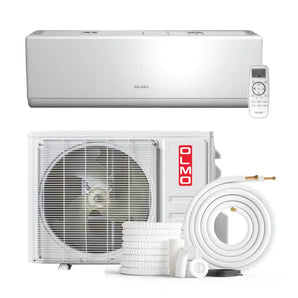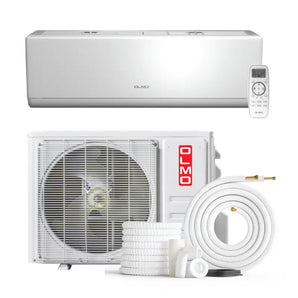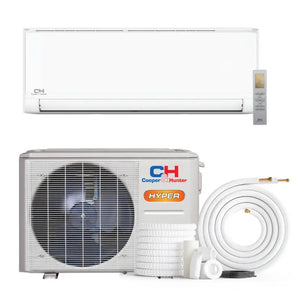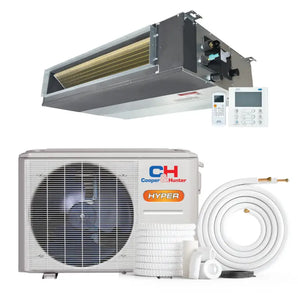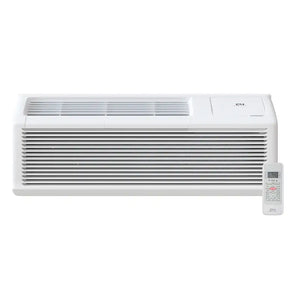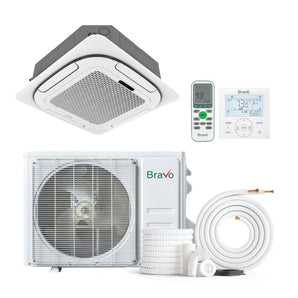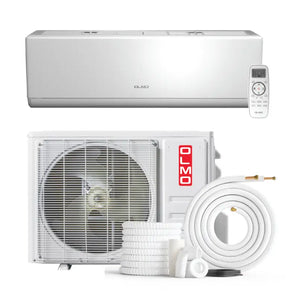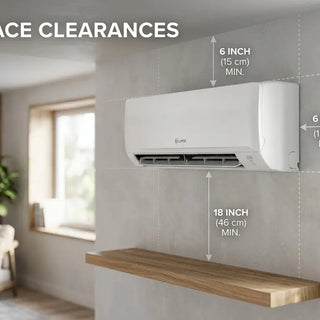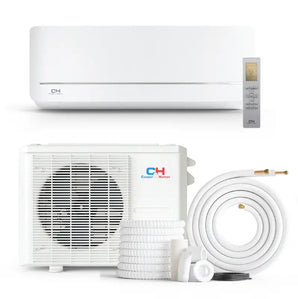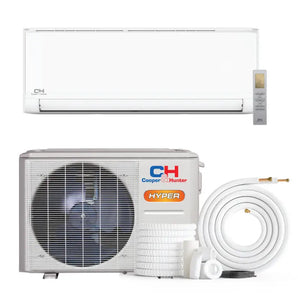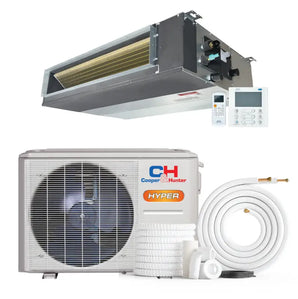


Mini Split Heat Pump Systems for Brooklyn, NY
Ductless heat pump systems for Brooklyn brownstones, row houses, Williamsburg lofts, Park Slope co-ops, and multi-family walk-ups. One system heats to -22°F in winter and cools through July's 85°F heat. Ships from Medley, FL — free freight to all Brooklyn neighborhoods in 3–5 business days. NYSERDA rebates up to $500/ton, no NY sales tax.
Why Brooklyn buildings are ideal for ductless mini splits
Brooklyn is the most populous of NYC's five boroughs — 2.7 million residents across Kings County, spread through some of the most architecturally diverse urban housing in America. The overwhelming majority of Brooklyn's housing stock was built before 1960, long before central forced-air ductwork was standard. Brownstones in Park Slope and Crown Heights, row houses in Bay Ridge and Bensonhurst, multi-family walk-ups in Flatbush and Bushwick, and industrial loft conversions in Williamsburg and DUMBO all share one common trait: no ductwork, and no practical way to add it. Ductless mini split heat pumps were invented for exactly this building type. A single refrigerant line runs through a 3-inch hole in the wall — no demolition, no ductwork, no dropped ceilings. And because it's a heat pump, one system replaces both your summer AC and your winter heat source, making it the most economical HVAC upgrade available for Brooklyn's climate.
-
Pre-1960 Buildings — No Ductwork Required
More than 70% of Brooklyn's residential buildings were constructed before central air conditioning existed. Adding forced-air ductwork to a 5-story brownstone or a prewar walk-up requires opening walls, dropping ceilings, and structural work costing $25,000–$60,000 or more — before a single unit of cooling is installed. Mini splits require only a 3-inch penetration through an exterior wall. Our smallest units can be fully operational within a day of install, with no structural modifications. That's why contractors, co-op boards, and condo associations throughout Park Slope, Crown Heights, Flatbush, and Bay Ridge strongly prefer ductless systems for retrofit installations.
-
Replace Expensive Electric Baseboard Heat — Save 50–70%
Electric baseboard resistance heating is the most expensive form of heat available — it converts electricity to heat at a 1:1 ratio. A mini split heat pump moves heat from outdoor air into your home at a ratio of 2.5:1 to 4:1, meaning for every unit of electricity consumed, you receive 2.5–4 units of heat. On ConEd's residential rates, a Brooklyn homeowner heating 1,000 sq ft with baseboard heat may spend $400–$600/month in winter. The same space heated by a cold-climate heat pump costs $120–$200/month — a 50–70% reduction. Cooper & Hunter's cold-climate models are rated to -22°F operation, maintaining full heating capacity through Brooklyn's typical January lows of 30°F.
-
Year-Round Comfort — Brooklyn Winters Are Cold, Summers Are Hot
Brooklyn's climate swings between extremes. Average July highs reach 85°F with high humidity — window AC units struggle and consume enormous amounts of power on ConEd's already-high rates. Average January lows drop to 25–30°F — cold enough to expose the limitations of baseboard heat and steam radiators. A properly sized mini split heat pump handles both seasons from a single system. Our ENERGY STAR certified Cooper & Hunter, OLMO, and BRAVO units achieve SEER ratings of 18–22 for summer cooling and HSPF ratings of 9–11 for winter heating — making them the most efficient all-season solution available for Brooklyn apartments and homes.
-
Free Freight Shipping — Medley, FL to Brooklyn in 3–5 Business Days
Mini split systems ship as LTL freight — they weigh 80–180 lbs and require pallet delivery. Carriers charge $200–$400 for residential LTL freight when billed separately. We include free freight shipping on all orders over $300 to every Brooklyn neighborhood — from Bay Ridge and Bensonhurst to Greenpoint and DUMBO. The route from our Medley, FL warehouse to NYC metro is approximately 1,280 miles. Our freight partners deliver to Brooklyn addresses in 3–5 business days. You'll receive tracking once the shipment leaves our dock.
-
NYSERDA Rebates + Federal Tax Credit + No NY Sales Tax
New York State Energy Research & Development Authority (NYSERDA) offers heat pump rebates up to $500 per ton of capacity for qualifying systems. On a 2-ton (24,000 BTU) system, that's $1,000 back. Add the federal Section 25C tax credit of up to $2,000 for qualifying heat pump installations, and New York's exemption from sales tax on energy-efficient HVAC equipment — and the total incentive stack on a mid-size Brooklyn installation can exceed $3,000. All our ENERGY STAR certified units qualify. See nyserda.ny.gov for current program details.
Brooklyn climate & delivery facts
Cold-climate heat pumps built for Brooklyn winters
Brooklyn winters are real — January lows regularly drop to 25°F, and polar vortex events push temperatures below 10°F. Our cold-climate heat pump models are rated to operate at full capacity down to -22°F, making them suitable as primary heating systems for Brooklyn brownstones, apartments, and multi-family buildings.
COP ratings — what they mean for your heating bill
COP (Coefficient of Performance) measures heating efficiency. Electric baseboard resistance heat has a COP of 1.0 — one unit of electricity produces one unit of heat. Our cold-climate mini splits achieve COP ratings of 2.5 to 4.0 at typical Brooklyn winter temperatures. At 17°F — a common mid-winter Brooklyn low — a Cooper & Hunter cold-climate unit maintains a COP of approximately 2.5, meaning you get 2.5x as much heat per dollar spent compared to baseboard heating. At 30°F (Brooklyn's average January low), COP climbs to 3.0–3.5. On ConEd's residential electric rates, these efficiency gains translate directly to 50–70% lower monthly heating costs versus resistance heat.
Replacing oil or steam heat — Brooklyn conversions
Many Brooklyn multi-family buildings and brownstones still use oil-fired steam or hot water heating — systems installed in the 1950s–1970s. Oil heat in NYC has become extremely expensive, with costs regularly exceeding $5 per gallon. A full-building conversion from oil to electric mini split heat pumps can reduce annual heating costs by 40–60% depending on system age and efficiency. Mini splits also eliminate the boiler room footprint, oil tank removal costs, and annual burner maintenance. For brownstone owners converting floor-by-floor, our 2–5 zone multi-split systems allow full-building HVAC coverage with a single outdoor condenser per unit or per floor — minimizing condenser placement complexity on tight Brooklyn lots.
Cooper & Hunter -22°F rated models
Standard mini splits from mass-market brands begin to lose heating capacity below 32°F — at 17°F, many budget systems are producing less than 60% of rated heat output. Cooper & Hunter's Hyper Heat and Ductless Pro cold-climate product lines are rated to maintain full heating capacity down to 5°F and continued operation at -22°F. This means a properly sized cold-climate unit in a Flatbush apartment or a Park Slope brownstone delivers full heating output through Brooklyn's coldest nights without any backup electric resistance kicking in. Verified by AHRI (Air-Conditioning, Heating, and Refrigeration Institute) testing — not just marketing claims.
Savings vs. window AC + baseboard heat
The most common HVAC setup in older Brooklyn apartments is window AC units in summer plus electric baseboard or steam heat in winter — two completely separate, inefficient systems. A single mini split heat pump eliminates both. Window AC units typically achieve SEER ratings of 10–12 and require installation and removal each season. A ductless mini split at SEER 18–22 cools 40–50% more efficiently than a window unit and heats 2.5–4x more efficiently than baseboard resistance heat. For a Brooklyn apartment spending $200/month on window AC (summer) and $350/month on baseboard heat (winter), switching to a mini split typically reduces annual HVAC costs by $1,500–$2,500 — usually recovering the equipment cost within 2–4 years before rebates.
Cold-climate heat pump performance at Brooklyn temperatures
Brooklyn's heating design temperature (the coldest temperature used for load calculations) is approximately 14°F — meaning your heating system must deliver full output at that temperature to keep your building comfortable on the coldest nights. Standard mini splits often cannot. Our Cooper & Hunter cold-climate models are tested and AHRI-rated at 5°F and 17°F conditions — the two benchmarks that matter most for NYC heating performance.
For brownstone owners replacing steam or baseboard heat as the primary heat source, cold-climate performance ratings are critical. A system that loses 40% of heating capacity at 20°F will leave you cold on January nights and force you to supplement with expensive resistance heat — eliminating the efficiency advantage. Call 855-775-4822 to identify the right cold-climate model for your Brooklyn building type.
What size mini split for your Brooklyn home or apartment?
Brooklyn is in ASHRAE Climate Zone 4A — mixed-humid, requiring accurate sizing for both summer cooling and winter heating. Use 15–20 BTU per square foot for newer insulated buildings; 20–25 BTU for prewar construction with older windows and walls.
- Small brownstone bedroom
- Studio apartment
- Home office / den
- 1BR apartment floor
- Brownstone parlor floor
- Row house main bedroom
- 1BR–2BR apartment
- Williamsburg open loft space
- Brownstone garden/parlor floor
- 2BR–3BR apartment or duplex
- DUMBO loft conversion
- Row house full floor
- Full brownstone or row house
- Large loft — 1,500+ sq ft
- Small commercial retail space
Brooklyn sizing tip: Prewar construction (pre-1940s) typically has thinner walls, original single-pane windows, and minimal wall insulation — size toward the higher end of each range (20–25 BTU/sq ft). Post-2000 renovated units with replacement windows and spray foam insulation can size closer to 15 BTU/sq ft. High ceilings common in Williamsburg lofts and DUMBO conversions add volume — factor ceiling height above 9 feet into your calculation. Use our free BTU Calculator for a precise room-by-room estimate.
Multi-zone mini splits for Brooklyn brownstones and multi-family buildings
One outdoor condenser, multiple indoor heads — ideal for full brownstone installs, multi-family conversions, and buildings with 2–5 separate living spaces. A single condenser on the roof or rear yard runs up to 5 indoor zones independently.
Multi-zone systems are the preferred solution for Brooklyn's prewar brownstones and row houses. A typical 4-story brownstone with a garden floor, parlor floor, and two upper floors can be fully climate-controlled by two 3-zone multi-split systems — one condenser per pair of floors — using just two exterior condensers on the roof or rear yard. This approach satisfies most co-op and condo board requirements for minimizing visible HVAC equipment while delivering independent temperature control for each floor. Call 855-775-4822 for multi-zone sizing help specific to your Brooklyn building.
NYSERDA rebates, federal tax credits & NY sales tax exemption
New York offers one of the most generous incentive stacks in the country for heat pump installations. Brooklyn homeowners and landlords can combine NYSERDA rebates, the federal 25C tax credit, and the NY sales tax exemption to dramatically reduce the net cost of a mini split system.
NYSERDA Heat Pump Rebates
- New York State Energy Research & Development Authority (NYSERDA) offers rebates up to $500 per ton of capacity for qualifying cold-climate heat pump systems — visit nyserda.ny.gov for current program details
- On a 2-ton (24,000 BTU) system, NYSERDA rebates can total $1,000. A 3-ton (36,000 BTU) install qualifies for up to $1,500 in NYSERDA rebates
- All our ENERGY STAR certified Cooper & Hunter, OLMO, and BRAVO heat pump systems qualify for NYSERDA's Clean Heat program
- NYSERDA rebates are available to both residential homeowners and multi-family building owners in Brooklyn and throughout New York State
- Rebate application is submitted through your Con Edison account and NYSERDA's portal after installation — your licensed HVAC contractor typically handles the paperwork
- Call 855-775-4822 for current ENERGY STAR documentation and AHRI certificates to support your NYSERDA application
Federal 25C Heat Pump Tax Credit
- The Inflation Reduction Act Section 25C tax credit provides 30% of equipment cost, up to $2,000 per year, for qualifying heat pump installations in owner-occupied primary residences
- The credit applies to the cost of the heat pump equipment itself — installation labor is not included in the calculation
- Combined with NYSERDA rebates, a Brooklyn homeowner purchasing a $3,500 mini split system may receive $1,000 in NYSERDA rebates + $1,050 in federal tax credit = $2,050 in total incentives on a $3,500 purchase
- The credit can be claimed annually — owners replacing multiple zones over 2–3 years can claim up to $2,000/year each year
- Consult a tax professional to confirm eligibility for your specific situation — generally applies to qualifying ENERGY STAR heat pumps
- IRS Form 5695 is used to claim the residential energy credit when filing federal taxes
No NY Sales Tax on HVAC Equipment
- New York State exempts energy-efficient HVAC equipment — including qualifying heat pump systems — from state and local sales tax under the energy conservation and efficiency exemption
- In New York City (including Brooklyn), combined state + city sales tax rates total 8.875% — on a $3,500 system, this exemption saves $311 at checkout
- The exemption applies automatically to qualifying equipment — no special application or form is needed when purchasing from an authorized dealer
- All Cooper & Hunter, OLMO, and BRAVO ENERGY STAR certified heat pump systems we sell qualify for the NY sales tax exemption
- Combined with NYSERDA rebates and the federal 25C tax credit, the total incentive stack on a $5,000 multi-zone installation can exceed $3,000 in savings
- Contact our team at 855-775-4822 to confirm exemption documentation for your purchase
Example savings on a Brooklyn 2-ton (24,000 BTU) installation
System price: $2,800 (equipment only, authorized dealer pricing). NY sales tax exemption saves $248 at checkout. NYSERDA Clean Heat rebate: up to $1,000 for a 2-ton cold-climate system. Federal 25C tax credit: 30% of equipment cost up to $2,000 = $840 credit on your federal return. Total incentives: $2,088 on a $2,800 equipment purchase — bringing the net equipment cost to approximately $712 before installation labor.
Plus annual heating savings of $1,500–$2,500 versus electric baseboard heat in a typical Brooklyn apartment — equipment cost is typically recovered in 12–18 months after rebates. These figures are estimates; consult your HVAC contractor and tax advisor for exact calculations.
NYC DOB permit requirements for Brooklyn mini split installations
All mechanical HVAC work in New York City — including new mini split installations — requires a permit filed with the NYC Department of Buildings (DOB). A licensed NYC HVAC contractor must perform the work and file all permit applications. Here's what Brooklyn property owners need to know.
NYC DOB Filing Process
- All new mini split installations in NYC require a mechanical work permit filed through the NYC DOB — apply at nyc.gov/buildings or through your licensed contractor via the DOB NOW portal
- For most residential mini split installs in Brooklyn, a PW1 (Plan/Work Application) filing is required — your contractor files this before work begins
- Larger-scale installations (full building HVAC conversion, multiple zones, commercial applications) may require an Alt-1 (full application) with engineered drawings submitted by a PE or RA
- After installation is complete, a DOB mechanical inspection must be scheduled and passed before the system is legally placed in service
- Permit fees vary by scope — typical residential mini split permits run $100–$400 in filing fees
- We provide complete manufacturer documentation (spec sheets, installation manuals, AHRI certificates) to support your contractor's DOB filing — call 855-775-4822
Licensed NYC HVAC Contractor Requirements
- All refrigerant HVAC work in NYC must be performed by a contractor holding an NYC Master Plumber or Refrigeration license, or by a licensed Journeyman under a licensed master — verify at nyc.gov/dob
- The licensed contractor is responsible for all DOB filings, permit applications, and scheduling the final mechanical inspection
- Unlicensed installation voids the manufacturer warranty, will fail DOB inspection, and can result in violations, stop-work orders, and fines from NYC Buildings
- EPA Section 608 certification is required for handling refrigerants (R-410A, R-32, R-454B) — all licensed NYC contractors must hold this certification
- NYC buildings with co-op or condo boards typically require the contractor's license information as part of the board approval package before work can begin
Co-op & Condo Board Approvals
- Most Brooklyn co-ops and condos require board approval before any HVAC installation — this is separate from (and must precede) the NYC DOB permit process
- Board approval packages typically include: the manufacturer's specification sheet, proposed equipment location with photos or drawings, the contractor's license and insurance certificates, and the NYC DOB permit application number
- We provide free manufacturer documentation packages — spec sheets, installation manuals, AHRI certificates, and ENERGY STAR certification letters — to support your board application. Call 855-775-4822 and we'll email everything you need
- Brownstone owners (fee-simple townhouses) do not require co-op/condo board approval but still need NYC DOB permits and licensed contractor installation
- For larger buildings seeking NYSERDA rebates, Con Edison may require proof of board authorization as part of the rebate application
Serving every Brooklyn neighborhood
We ship mini split systems to every Brooklyn ZIP code — from the waterfront neighborhoods of DUMBO and Greenpoint to the inland communities of Flatbush, Canarsie, and Borough Park. All orders include free LTL freight delivery.
Not sure if we deliver to your exact address? Call us at 855-775-4822 or use our contact form — we ship to every residential and commercial address in Kings County with free LTL freight on orders over $300.
Mini split questions for Brooklyn, NY
How do I size a mini split for a Brooklyn brownstone room?
Brownstone rooms are typically 150–350 sq ft per room depending on floor layout — but sizing is more complex than square footage alone. Brooklyn brownstones (ASHRAE Zone 4A) should use 18–22 BTU per square foot for prewar construction with original windows and walls, and 15–18 BTU for renovated units with replacement windows and added insulation. A classic 250 sq ft brownstone parlor-floor room needs approximately 5,000–5,500 BTU — a 9,000 BTU unit (the minimum standard size) will cover it with capacity to spare and provides better dehumidification than an undersized unit running at full load continuously. For open-plan floor layouts covering 600–900 sq ft (common in Williamsburg loft conversions), an 18,000 BTU unit is the starting point. High ceilings (10–14 feet in many prewar buildings) add heating volume — increase sizing by 10–15% for rooms with ceiling heights above 9 feet. Use our free BTU Calculator for a precise room-by-room estimate.
How do NYSERDA rebates work and how do I claim them in Brooklyn?
NYSERDA (New York State Energy Research & Development Authority) operates the Clean Heat program, which provides rebates up to $500 per ton of capacity for qualifying cold-climate heat pump systems. For Brooklyn residents, the rebate is administered through Con Edison (coned.com) as part of NYSERDA's utility partner program. The process: (1) Purchase a qualifying ENERGY STAR certified heat pump system — all units we sell qualify. (2) Have the system installed by a licensed NYC contractor. (3) Submit a rebate application through the Con Edison/NYSERDA portal at nyserda.ny.gov within 90 days of installation. (4) Receive rebate payment by check or account credit, typically within 6–8 weeks. Your licensed contractor may also be registered as a participating Trade Ally and can process the rebate application on your behalf. Call 855-775-4822 for current AHRI and ENERGY STAR documentation to support your application.
Do I need co-op or condo board approval to install a mini split in Brooklyn?
If you own a co-op or condo unit in Brooklyn — which covers a significant percentage of Brooklyn's apartment stock — you almost certainly need board approval before installing a mini split. The board approval process is separate from (and typically precedes) your NYC DOB permit. Most boards require a written application that includes the manufacturer's specification sheet showing unit dimensions and capacity, photos of the proposed indoor head and outdoor condenser locations, your contractor's license and insurance certificates, and the proposed installation timeline. We provide free documentation packages including spec sheets, installation manuals, AHRI certificates, and ENERGY STAR certification letters for any unit we sell — call 855-775-4822 or use our contact form and we'll email the complete package within 24 hours. Brownstone owners (fee-simple townhouses) do not need board approval but do require NYC DOB mechanical permits.
Can a mini split heat pump replace my baseboard electric heat in Brooklyn?
Yes — and for most Brooklyn apartments and homes with electric baseboard heat, replacing it with a mini split heat pump is one of the highest-ROI home improvements available. Electric baseboard heat converts electricity to heat at a 1:1 ratio (COP 1.0). Our Cooper & Hunter cold-climate heat pumps achieve a COP of 2.5–3.5 at typical Brooklyn winter temperatures (17°F–30°F), meaning you get 2.5–3.5x as much heat per dollar spent. The key is choosing a cold-climate model — not a standard mini split. Standard mini splits from budget brands often lose 30–50% of heating capacity below 32°F, making them unreliable as primary heat sources in Brooklyn winters. Cooper & Hunter's Hyper Heat and Ductless Pro lines are AHRI-rated at 5°F and operate continuously down to -22°F — making them fully capable of replacing baseboard heat as the primary heating system in Brooklyn apartments. Size the unit correctly and you'll be comfortable through January without any supplemental heat.
How do you install a mini split in an old Brooklyn building with no ductwork?
Ductless mini split installation in a prewar Brooklyn building requires no ductwork — that's the entire point. The installation process: (1) The indoor wall-mount head unit is positioned on an interior wall, typically high on the wall for optimal air distribution. (2) A 3-inch hole is core-drilled through the exterior wall (or through the floor/ceiling to a rear wall) for the refrigerant lines, condensate drain, and electrical conduit. (3) The outdoor condenser is mounted on the roof, exterior wall bracket, or rear yard pad — placement depends on building type and board requirements. (4) Refrigerant lines connect indoor and outdoor units through the wall penetration. (5) A licensed electrician connects the dedicated electrical circuit required for the system. (6) The contractor vacuums the refrigerant lines, charges the system, and verifies operation. A typical single-zone installation takes 4–8 hours. The 3-inch wall penetration is sealed and weatherproofed — smaller and less invasive than a window AC sleeve. No dropped ceilings, no structural work, no drywall beyond patching the small penetration hole.
How long does delivery take to Brooklyn from your warehouse?
We ship from our Medley, FL warehouse — approximately 1,280 miles from Brooklyn. Mini split systems ship as LTL (Less than Truckload) freight on pallets. Brooklyn delivery typically takes 3–5 business days after the order ships. Free freight shipping is included on all orders over $300 — no hidden residential delivery charges or liftgate fees. You'll receive a tracking number once your order leaves our Medley dock. For time-sensitive installations, call us at 855-775-4822 to confirm current lead times and coordinate delivery to match your contractor's schedule. Note: LTL freight is delivered to the curb — the freight carrier does not bring equipment inside the building. Arrange for help to move equipment from the curb to your installation site.
What brands do you carry and are they suitable for Brooklyn's cold winters?
We carry Cooper & Hunter, OLMO, and BRAVO mini splits — and we are an authorized dealer for all three brands. For Brooklyn's winters, the most important specification is low-ambient heating performance. Cooper & Hunter's cold-climate lines (Hyper Heat, Ductless Pro) are specifically engineered and AHRI-rated for cold-climate operation — rated to maintain full heating capacity at 5°F and operate continuously down to -22°F. These are the models we recommend for Brooklyn homeowners replacing baseboard or oil heat as the primary heat source. OLMO and BRAVO offer excellent SEER-rated cooling efficiency and are strong choices for buildings where heating is supplemental (radiators or steam heat remain in place) and the mini split is primarily for cooling with secondary heating. Grey-market units sold by unauthorized resellers have manufacturer warranties voided — buying from us as an authorized dealer ensures your warranty is valid and the equipment can be verified by the manufacturer. Call 855-775-4822 to identify the right cold-climate model for your Brooklyn building.
Can one multi-zone system handle an entire Brooklyn brownstone?
Yes, with the right configuration. A typical 4-story Brooklyn brownstone (approximately 3,200–4,500 sq ft total) can be fully climate-controlled with two multi-zone systems — for example, a 5-zone 48,000 BTU outdoor unit serving 5 indoor heads across 3–4 floors. Many brownstone owners prefer this approach because it minimizes the number of outdoor condensers, which matters for roof rights, co-op board approvals, and aesthetics. For a fully owner-occupied brownstone, a 3-zone system per pair of floors works well — one condenser on the rear of the building serving the garden floor and parlor floor (24K+18K+12K BTU heads), and a second condenser serving the upper two floors. Total: 2 outdoor units, 6 indoor heads, complete climate control throughout the building. For rental brownstones with separate units on each floor, separate single-zone or 2-zone systems per unit give each tenant independent control. Call 855-775-4822 — we can walk through the right configuration for your specific Brooklyn brownstone layout.
Is there sales tax on mini splits purchased for Brooklyn?
No. New York State exempts qualifying energy-efficient HVAC equipment — including heat pump systems — from state and local sales tax under the energy conservation equipment exemption. In New York City (Brooklyn is Kings County, NY), combined state + city sales tax is 8.875%. This exemption applies automatically at checkout when purchasing qualifying ENERGY STAR certified heat pump equipment from us — you pay no sales tax on the equipment itself. On a $3,500 system, this saves $311 compared to purchasing taxable equipment. The exemption applies to the HVAC equipment cost; installation labor by your contractor is a separate contract and may be subject to different tax treatment. All our ENERGY STAR certified mini split heat pump systems qualify. This exemption stacks with NYSERDA rebates and the federal 25C tax credit for maximum total savings.
Mini split heat pump systems across New York
City and borough guides for every New York market — all ship from our Medley, FL warehouse within 3–5 business days