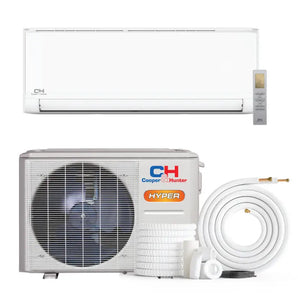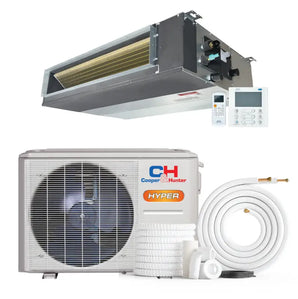
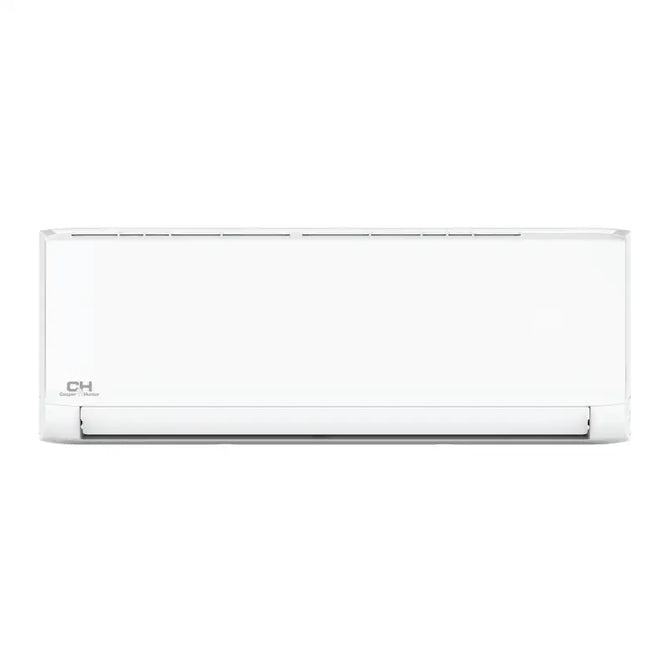
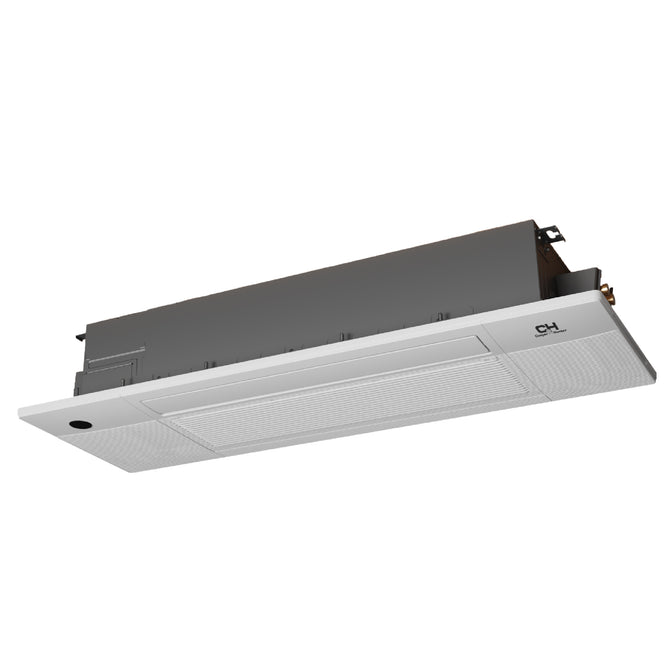



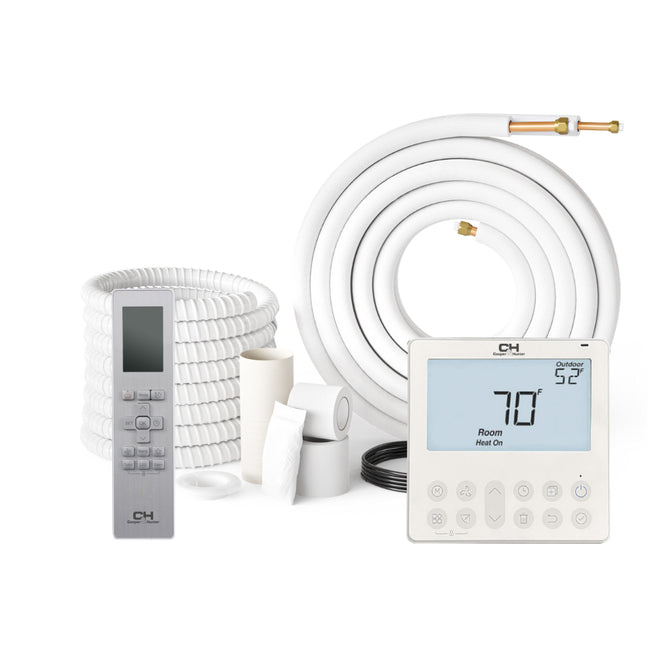
Mini Split Heat Pump Systems for Manhattan, NY
Ductless mini split heat pump systems for Manhattan apartments, pre-war buildings, condos, and lofts. Heat AND cool year-round with one efficient system — no ductwork, no window AC, no steam radiator limitations. Ships free from our Medley, FL warehouse in 3–5 business days via LTL freight. Authorized dealer for Cooper & Hunter, OLMO, and BRAVO. NYSERDA rebates up to $500/ton available. No NY sales tax on qualifying equipment.
Why Manhattan residents choose mini split heat pumps
Manhattan is the densest urban county in the United States — 1.6 million people living in New York County, spanning 22.8 square miles of pre-war walk-ups, post-war high-rises, luxury condos, and converted lofts. The borough presents a unique set of HVAC challenges found nowhere else in the country: buildings constructed between 1900 and 1940 that rely entirely on steam radiator heat with no cooling system whatsoever; co-op and condo boards that regulate every exterior modification from condenser placement to lineset routing; ConEd electricity rates that rank among the highest in the continental US; and summers that regularly reach 90°F+ humidity alongside winters that drop to 25°F average lows. Mini split heat pumps solve all of these problems in a single, ductless system — delivering precise zone-level heating and cooling without tearing open walls or installing ductwork in buildings that were never designed for it.
-
Pre-War Buildings Get A/C for the First Time — No Ductwork Required
The majority of Manhattan's residential stock was built before World War II — buildings with steam radiator heat, thick masonry walls, and no mechanical cooling whatsoever. For a century, residents in Upper West Side brownstones, Harlem walk-ups, and Washington Heights pre-wars endured summer without air conditioning or relied on noisy, inefficient window units that must be removed each fall. Mini split systems install through a 3-inch hole in the exterior wall for the refrigerant lineset, requiring no ductwork, no central air chase, and no major structural work. The indoor air handler mounts to the wall or ceiling; the condenser sits on a balcony, rooftop, or exterior pad. The result: permanent, quiet, efficient cooling in a 1920s building that was never designed for it.
-
Replace Window ACs Permanently — Quieter, More Efficient, No Seasonal Removal
Window air conditioners are the dominant cooling solution in Manhattan apartments, but they are loud (55–70 dB), inefficient (SEER ratings of 8–12 vs. mini split SEER ratings of 18–25+), must be removed and stored every winter, and create security vulnerabilities in ground and low-floor units. Mini splits operate at 19–26 dB in sleep mode — quieter than a whisper — and remain permanently installed year-round. Because they are heat pumps, they also provide heating in winter, allowing residents to supplement or replace drafty steam radiators with precise thermostat-controlled heat at the zone level. For Manhattan tenants and owners who have tolerated window ACs for decades, a mini split is a fundamental quality-of-life upgrade.
-
ConEd Rates Among the Highest in the US — Efficiency Pays Back Fast
Con Edison (coned.com) serves all of Manhattan, and ConEd residential electricity rates are consistently among the highest in the continental United States — routinely 22–28 cents per kWh compared to the national average of 12–14 cents. At these rates, every point of SEER improvement translates to real dollar savings. A mini split with a SEER2 rating of 20 running in a Manhattan apartment costs roughly 40–50% less to operate than an old window AC with a SEER of 10. In winter, heat pump heating provides 2–3 kWh of heat for every 1 kWh of electricity consumed (COP of 2–3), compared to 1:1 efficiency of electric resistance baseboard heat. For any Manhattan resident paying ConEd rates, efficiency is not a luxury feature — it is the fastest payback calculation in the country.
-
Precise Zone Control for Manhattan's Tiny Apartments
Manhattan apartment square footage is notoriously scarce — studios of 350–450 sq ft, one-bedrooms of 600–800 sq ft, and micro-apartments under 300 sq ft are standard. In a small apartment, zone control means not heating or cooling the bedroom when you're in the living room, or vice versa. Mini split systems allow independent temperature control in each room served by an indoor head. For larger Manhattan apartments — 2-bedroom prewar layouts, loft conversions in SoHo or Tribeca, or penthouse units with multiple exposures — a multi-zone system with 2–4 indoor heads off one outdoor condenser provides building-level efficiency while meeting the room-by-room needs that a single central system can never achieve.
-
Co-op & Condo Board Documentation Package Included
Manhattan is unique in the US for the density and authority of its co-op and condo boards. Installing any mechanical equipment — including a mini split condenser on a balcony, roof, or exterior wall — typically requires board approval in co-ops (which represent the majority of Manhattan's ownership housing stock) and architectural review in condo buildings. We provide a complete manufacturer documentation package at no charge — including spec sheets, installation manuals, AHRI certificates, ENERGY STAR documentation, and dimensional drawings — to support your board approval submission. Call 855-775-4822 and we'll email the full package for any unit you're considering, formatted for board submission.
Manhattan climate & delivery facts
Mini splits heat Manhattan winters — not just cool summers
A mini split is a heat pump, not just an air conditioner. At ConEd's rates, heat pump heating costs 2–3x less than electric resistance heat and dramatically less than electric baseboards. Cooper & Hunter's hyper-heat models are rated to deliver full capacity down to -22°F — more than enough for Manhattan's coldest nights.
How Heat Pumps Work in Cold Weather
A heat pump extracts heat energy from outdoor air — even at temperatures well below freezing — and moves it indoors. Unlike electric resistance heat (which converts 1 kWh of electricity into 1 kWh of heat), a heat pump moves 2–3 kWh of heat for every 1 kWh of electricity it consumes. This ratio is called COP (Coefficient of Performance). At 35°F — a typical Manhattan January day — a quality inverter mini split runs at COP 2.5 to 3.0. At 20°F — a cold Manhattan night — modern hyper-heat models maintain COP 1.8 to 2.2. Even at ConEd rates of 25 cents/kWh, heat pump heating costs 40–55% less than electric resistance baseboard heat at the same temperature. Compared to running an electric space heater in a pre-war Manhattan apartment with no central heat, the difference over a heating season is hundreds of dollars.
Steam Heat Supplement — A/C Without Removing Your Radiators
Many Manhattan pre-war buildings provide steam or hot water heat centrally — heat you cannot individually control, cannot turn off in late October when the boiler fires up, and cannot use for cooling in summer. A mini split system runs independently of the building's steam system. In winter, you can use the mini split for supplemental zone heating in rooms the radiators don't reach adequately (common in corner apartments and top-floor units). In shoulder seasons — October through November and March through May — when the building heat is off but temperatures fluctuate wildly — the mini split provides both heating and cooling on demand. The result is year-round comfort control that doesn't depend on when the building super decides to turn on the boiler.
Cooper & Hunter -22°F Cold Climate Rating
Standard mini split systems begin losing capacity below 17°F and shut off entirely below 5°F — a problem in northern climates. Cooper & Hunter's Hyper Heat series is rated to maintain full heating capacity down to 5°F and continue operating (at reduced capacity) down to -22°F. Manhattan's recorded all-time low is -15°F (February 1934), and modern extreme cold events occasionally push temperatures into the single digits and below zero. For Manhattan apartments that rely on a mini split as a primary heat source — studios and 1-bedrooms where the building's steam heat is unreliable or absent — a cold-climate rated system is not optional. Every Cooper & Hunter hyper-heat unit we sell is certified for New York winters.
ConEd Rate Math — Efficiency Saves Real Money
ConEd residential rates in Manhattan average 22–28 cents per kWh including supply, delivery, and surcharges — among the highest in the nation. For context, a standard 9,000 BTU window AC running 8 hours/day at SEER 10 costs roughly $1.10–$1.40 per day at ConEd rates. The same cooling load handled by a 9,000 BTU mini split at SEER2 22 costs $0.45–$0.58 per day — roughly 55–60% less. Over a 90-day Manhattan cooling season, that difference on one unit alone is $60–$75. For a 2-bedroom apartment with two cooling zones, the annual savings reach $120–$150 on cooling alone, before counting the heating season savings. The system pays for itself faster in Manhattan than virtually anywhere else in the US.
What size mini split for your Manhattan apartment?
Manhattan sits in ASHRAE Climate Zone 4A — hot-humid summers and cold winters. Use 15–20 BTU per square foot as a starting baseline. Pre-war buildings with poor insulation, large south/west windows, or top-floor sun exposure should size toward 20–22 BTU/sq ft.
- Manhattan studio apartment
- Micro-apartment (under 350 sq ft)
- Home office or bedroom zone
- Junior 1-bedroom apartment
- Large studio with alcove
- Pre-war bedroom suite
- Classic 1-bedroom prewar
- UWS / UES 1BR living area
- Chelsea or Greenwich Village 1BR
- 2-bedroom Manhattan apartment
- Gramercy or Murray Hill 2BR
- Tribeca or SoHo loft zone
- Penthouse or duplex loft
- Large Tribeca / SoHo full floor
- Financial District luxury condo
Manhattan sizing tip: Pre-war buildings (1900–1940s) have thicker masonry walls that hold heat well but often have single-pane windows and minimal ceiling insulation. Top-floor and corner units with multiple sun exposures should size up one step. High-rise luxury condos (2000s–present) with thermal glazing and tight envelopes can size closer to 15 BTU/sq ft. Use our free BTU Calculator for a precise estimate tailored to your building type and floor.
Multi-zone mini splits for Manhattan apartments, condos, and luxury installs
One outdoor condenser, multiple indoor heads — ideal for 2-bedroom and larger Manhattan apartments, luxury condos doing full HVAC overhauls, and loft conversions with open plans. A single board-approved condenser placement serves the entire apartment.
Multi-zone systems are especially important in Manhattan because co-op and condo boards typically approve one condenser location per unit. A properly designed multi-zone system places a single condenser — on the roof, balcony, or approved exterior location — while running linesets to 2–5 indoor heads throughout the apartment. Luxury condo buildings on the Upper East Side, Financial District, and Midtown are increasingly specifying full multi-zone mini split installs as a standard amenity. Call 855-775-4822 for multi-zone sizing help specific to your Manhattan building and floor plan.
NYSERDA rebates, federal 25C tax credit, and no NY sales tax
New York State and the federal government have stacked significant incentives for heat pump installations. Manhattan homeowners can combine NYSERDA rebates, the federal 25C tax credit, and NY's sales tax exemption for real savings on every qualifying system.
Call 855-775-4822 for current NYSERDA eligibility documentation, SEER2 ratings, and ENERGY STAR certificates for any unit you're considering. We provide everything your contractor needs to submit a NYSERDA rebate application and your tax professional needs to file the 25C credit. Learn more at nyserda.ny.gov.
NYC DOB permits, licensed contractors, and co-op/condo board packages
Every mini split installation in Manhattan requires a NYC Department of Buildings permit pulled by a licensed contractor. Co-op and condo owners also need board approval before the work begins. We make both processes easier.
NYC DOB Mechanical Permit (nyc.gov/buildings)
- All new mini split installations in Manhattan — whether a new system or equipment replacement — require a mechanical permit through the NYC Department of Buildings (NYC DOB) at nyc.gov/buildings
- A NYC-licensed mechanical contractor or HVAC professional must pull the permit; homeowners cannot self-permit HVAC installations in New York City
- NYC DOB requires permit applications to include equipment specifications, electrical load data, and proposed installation details including condenser placement and lineset routing
- A DOB inspection is required after installation is complete and before the system is legally placed in service; your contractor schedules the inspection through the DOB's online portal
- For buildings in landmark districts (common in Greenwich Village, SoHo, Tribeca, and parts of the Upper West and East Sides), exterior condenser placement may also require Landmarks Preservation Commission (LPC) review
- We provide full manufacturer documentation packages — spec sheets, installation manuals, AHRI certificates, electrical data — to support your contractor's DOB permit application. Call 855-775-4822 for the documentation package.
Co-op & Condo Board Approval Package
- The majority of Manhattan's owner-occupied housing is co-op apartments — buildings where the board has legal authority to approve or deny any modification to individual units, including HVAC equipment
- Most co-op and condo boards require a formal written approval request including the make/model of the equipment, proposed installation location with photographs or a site plan, and your licensed contractor's credentials and insurance certificate
- We provide a complete board approval documentation package at no charge: manufacturer spec sheets, dimensional drawings, AHRI certificates, ENERGY STAR documentation, decibel ratings for the condenser unit, and refrigerant safety data sheets
- Boards in landmark or historic buildings sometimes have additional aesthetic requirements for condenser housing or screening — we can provide custom-painted or screened condenser options on request
- For high-rise buildings where rooftop access is needed for condenser placement, we provide rooftop-ready condensers with appropriate vibration isolation mounting hardware
- Call 855-775-4822 or submit a contact form and we'll email a complete board package for your specific unit within one business day
High-Rise Rooftop & Outdoor Unit Placement
- For Manhattan high-rise buildings — condominiums in Midtown, Financial District, Murray Hill, and luxury towers on the Upper East and West Sides — the outdoor condenser is typically placed on the building rooftop or a designated mechanical floor
- Rooftop condenser installations require a licensed contractor familiar with NYC high-rise access protocols, proper structural anchoring, and DOB approval for rooftop mechanical equipment
- All Cooper & Hunter and OLMO units we carry are rated for outdoor installation in high-wind environments — important for buildings above 20 floors in Manhattan where wind loads are significant
- Lineset runs from rooftop to apartments can be 30–100+ feet; our systems are available with extended lineset configurations up to 164 feet to accommodate Manhattan high-rise floor-to-roof distances
- Low-rise buildings in Chelsea, Hell's Kitchen, and Inwood typically place condensers on rear setback areas, side yards, or balconies — subject to DOB setback requirements and co-op/condo rules
- We can provide technical drawings showing condenser footprint, lineset routing, and electrical requirements to support both the DOB permit and board approval submission
Serving all Manhattan neighborhoods — from Inwood to the Financial District
We ship mini split systems to every Manhattan ZIP code via LTL freight, 3–5 business days from our Medley, FL warehouse. Every neighborhood below is within our free freight shipping area.
All Manhattan ZIP codes are served: 10001 through 10282. LTL freight delivers curbside to your building address. Your contractor or building super coordinates liftgate delivery and equipment staging. Call 855-775-4822 to coordinate a specific delivery window for your installation schedule.
Ships from Medley, FL — Free LTL Freight to Manhattan
Our warehouse in Medley, FL ships mini split systems to Manhattan via LTL freight. The 1,280-mile transit takes 3–5 business days — equipment arrives curbside at your building address at no extra charge on orders over $300.
How freight delivery to Manhattan works
Mini split systems weigh 80–200 lbs and ship as palletized LTL (less-than-truckload) freight — not parcel delivery. When your order ships from our Medley, FL warehouse, we generate a BOL (Bill of Lading) and send you a tracking number linked to the freight carrier's tracking portal. The carrier routes the pallet through their regional hub network from South Florida to New York, typically taking 3–5 business days.
Delivery in Manhattan is curbside — the driver brings the pallet to the curb in front of your building using a liftgate truck. Your contractor, building super, or doorman accepts the delivery at the curb. If you need inside delivery or specific floor staging, contact us in advance so we can arrange additional services. For high-rise buildings, your contractor typically coordinates with building management for freight elevator access on delivery day.
Freight shipping is included free on all orders over $300 — no residential delivery surcharges, no fuel surcharges, no liftgate surprises at checkout. The price in your cart is the price you pay.
Warehouse address: 9400 NW 104th St #150, Medley, FL 33178
Mini split questions for Manhattan, NY
Can I install a mini split in a Manhattan pre-war building without ductwork?
Yes — this is exactly the use case mini split systems were designed for. Pre-war buildings (built between roughly 1900 and 1945) dominate Manhattan's residential stock and were designed around steam or hot water radiator heating with no provision for ductwork or central cooling. Installing a traditional central air conditioning system in a pre-war building requires constructing ductwork chases through walls and floors — an expensive, disruptive, and sometimes structurally impractical project in buildings with load-bearing masonry construction. A ductless mini split installs through a 3-inch core drill in the exterior wall for the refrigerant lineset; no ductwork, no dropped ceilings, no major structural work. The indoor air handler mounts to the wall in 2–4 hours of installation time. The condenser sits on a balcony, setback, or rooftop. For co-op and condo buildings, we provide a complete documentation package for board approval. Call 855-775-4822 to discuss your specific building type and we'll help you choose the right system.
Why is a mini split better than a window AC for my Manhattan apartment?
Window air conditioners are the default solution in Manhattan apartments, but they have significant drawbacks compared to a mini split: (1) Efficiency: Window ACs typically have SEER ratings of 8–12; mini splits run at SEER2 18–25+. At ConEd's 22–28 cent/kWh rates, the energy savings are substantial — often 40–55% lower operating cost. (2) Noise: Window ACs run at 55–70 dB; mini splits operate at 19–32 dB in cooling mode, with sleep modes as quiet as 19 dB. (3) Seasonal removal: Window ACs must be removed and stored each winter — a hassle in Manhattan apartments without storage space. Mini splits are permanent year-round installations. (4) Heating: A mini split is a heat pump — it provides both heating and cooling from one unit. Window ACs provide cooling only. (5) Security: Window-mounted units compromise window security on lower floors. Mini splits mount high on interior walls. (6) Aesthetics: Modern mini split indoor units are sleek wall mounts; window ACs are large, protruding, and block natural light. The upfront cost of a mini split is higher, but the operating economics, comfort level, and quality of life upgrade are significant at ConEd rates.
How do I get co-op board approval for a mini split in my Manhattan apartment?
Co-op board approval in Manhattan typically involves submitting a formal alteration agreement request that includes: the specific make and model of the equipment you plan to install; a proposed installation plan showing where the indoor unit will mount and where the condenser will be placed (balcony, rooftop, rear setback — depending on your building); photographs of the proposed condenser location; your licensed contractor's credentials, license number, and certificate of insurance; and a description of the lineset routing and any wall penetrations. Many boards also request the manufacturer's specification sheet, the condenser's decibel rating, and confirmation that the equipment complies with NYC DOB requirements. We provide a complete board approval documentation package at no charge for any unit we sell — including spec sheets, AHRI certificates, dimensional drawings, sound specifications, ENERGY STAR documentation, and refrigerant safety data sheets, all formatted for board submission. Call 855-775-4822 or submit our contact form and we'll email the full package within one business day.
What NYSERDA rebates are available for a Manhattan mini split installation?
NYSERDA (New York State Energy Research and Development Authority) offers heat pump rebates of up to $500 per ton of installed capacity through the Clean Heat program (nyserda.ny.gov). For a typical 1-ton (12,000 BTU) mini split, that's up to $500; a 2-ton (24,000 BTU) system qualifies for up to $1,000; a 3-ton (36,000 BTU) system up to $1,500. The rebate applies to qualifying heat pump systems installed in New York State residential buildings — including Manhattan co-ops and condominiums. Equipment must be installed by a licensed NY contractor and meet NYSERDA's efficiency requirements. All Cooper & Hunter, OLMO, and BRAVO models we sell are designed to meet those standards. Your installing contractor typically handles the NYSERDA rebate application through NYSERDA's program portal, using documentation that we provide. Additionally, the federal Section 25C tax credit provides 30% of equipment cost up to $2,000/year for qualifying heat pump installations in owner-occupied primary residences. Combined with New York's exemption from sales tax on qualifying energy-efficient HVAC equipment, the total incentive stack can reduce your out-of-pocket cost significantly. Call 855-775-4822 for current NYSERDA eligibility documentation for any specific model.
Where does the outdoor condenser go in a Manhattan high-rise building?
Outdoor condenser placement in Manhattan high-rise buildings depends on building type, floor, and what your co-op/condo board and NYC DOB will approve. Common placement options include: (1) Rooftop — the most common solution for high-rise condos and co-ops. The condenser sits on the roof with appropriate vibration isolation mounts; linesets run vertically through the building's mechanical chase or exterior riser to your apartment. This requires building management coordination and DOB rooftop mechanical permit approval. (2) Balcony — for buildings with private balconies, the condenser typically sits on the balcony floor with a proper anti-vibration pad. Board approval is usually required and some buildings restrict balcony mechanical equipment for aesthetic reasons. (3) Setback terraces and rear yards — for low-rise walk-ups and townhouse buildings in Chelsea, West Village, Harlem, and similar neighborhoods, condensers are often placed on rear setback areas or yards at ground or lower-floor levels. (4) Exterior wall brackets — for buildings where rooftop and balcony placement is not available, the condenser can mount on a wall bracket at an approved exterior location. Our units support extended lineset runs of up to 164 feet to accommodate the distance from rooftop condensers to mid-building apartments. We provide technical drawings showing condenser dimensions, weight, and lineset routing to support both your co-op board submission and the NYC DOB permit application.
Do mini splits work efficiently in Manhattan winters?
Yes — modern inverter-driven mini splits are highly effective heat pumps for New York winters. Manhattan's average winter lows are in the mid-20s°F, with extreme cold events occasionally dropping below 10°F. Standard mini splits begin losing efficiency below 17°F; Cooper & Hunter's Hyper Heat series maintains full rated heating capacity down to 5°F and continues to operate at reduced capacity down to -22°F — well below any temperature Manhattan is likely to experience. At 35°F (a typical January day), a Hyper Heat unit runs at a COP of approximately 2.5–3.0, meaning it delivers 2.5–3 kWh of heat for every 1 kWh of electricity. At ConEd rates of 25 cents/kWh, this makes heat pump heating cost roughly 40–55% less than electric resistance heating (baseboards, space heaters) at the same temperature. For Manhattan apartments that use mini splits as supplemental heat — particularly in pre-war buildings where steam heat is inconsistent or overpowers in shoulder seasons — the system provides precise thermostat control and operates efficiently in both heating and cooling modes year-round. We strongly recommend Hyper Heat models for any Manhattan installation where heating is a primary use case.
How does shipping to Manhattan work — how long does it take?
We ship mini split systems to all Manhattan ZIP codes via LTL (less-than-truckload) freight from our Medley, FL warehouse — approximately 1,280 miles from New York City. Transit time is typically 3–5 business days. Orders placed before our daily shipping cutoff ship the same or next business day. Once your order ships, you'll receive a tracking number for the freight carrier's portal so you can monitor transit and coordinate the delivery appointment with your building management or contractor. Delivery is curbside — the freight carrier brings the palletized equipment to the street in front of your building using a liftgate truck and you or your building super accepts delivery at the curb. Free freight shipping is included on all orders over $300 — no residential surcharges, no fuel surcharges, no surprise liftgate fees at checkout. For installations with firm contractor start dates, call us at 855-775-4822 and we can coordinate the order to target a specific delivery window.
How do ConEd electricity rates affect mini split payback in Manhattan?
Con Edison's residential electricity rates in Manhattan are among the highest in the continental US — averaging 22–28 cents per kWh including supply, delivery, and surcharges. These high rates actually make the payback period for a mini split system shorter in Manhattan than almost anywhere else in the country. Here's the math: A standard window AC (SEER 10) running 8 hours/day costs approximately $1.25/day at 25 cents/kWh. The same cooling load handled by a mini split (SEER2 22) costs approximately $0.55/day — a savings of roughly $0.70/day. Over a 90-day Manhattan cooling season, that's $63 saved per cooling zone. For a 1-bedroom apartment with two zones, the annual cooling savings alone are $120–$130. Add heating season savings — heat pump heating at COP 2.5 vs. electric resistance heat at COP 1.0 — and the combined annual savings on a 1-bedroom Manhattan apartment typically reach $200–$350/year, depending on usage. A system that costs $800–$1,200 installed (before rebates) can pay for itself in 3–5 years of operating savings at ConEd rates, with NYSERDA rebates and the 25C tax credit further reducing the effective upfront cost. Call 855-775-4822 for a savings estimate specific to your apartment's size and current heating and cooling costs.
Mini split heat pump systems across New York
City and borough guides for every New York market — all ship from our Medley, FL warehouse within 3–5 business days